When Network Isn’t The Culprit
When a Teams call drops to silence mid-conversation, the fallout is instant. Operations pause. Users blame the network. Leadership demands answers. Yet, fewer than 1% of such performance degradations originate within enterprise networks themselves. Even Martello’s State of Microsoft 365 Performance Management found that about 25% of Teams issues come from Microsoft itself, the rest trace back to service providers, CDNs, DNS, or end-user devices. This is the paradox at the heart of modern operations, the network is both the foundation of digital experience and the easiest target when performance falters.
But what if network teams could prove the network’s innocence before diving into hours of diagnostics? Now they can, thanks to LinkEye’s Digital Experience (DX Agent), an intelligent observability layer that exposes the real source of performance degradation in seconds.
Even Martello’s State of Microsoft 365 Performance Management confirms that roughly 25% of Teams incidents originate within Microsoft’s own environment.
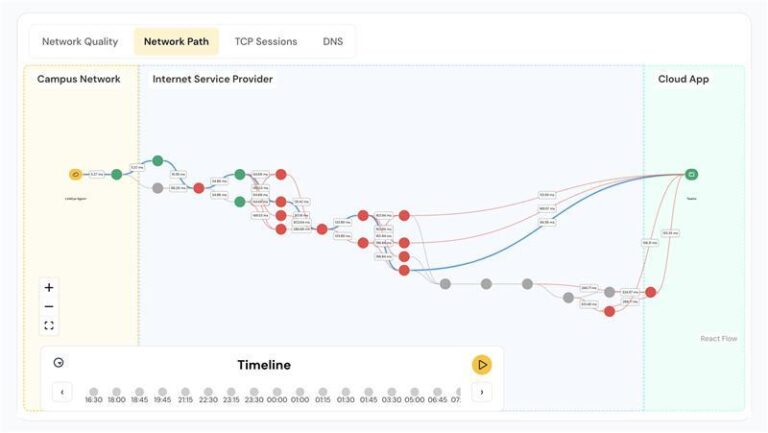
When Teams performance drops at a branch office, the Digital Experience Agent (DX Agent) traces the application journey from user device to the Microsoft’s cloud, and as a matter of fact, any application, aligning every anomaly in time to isolate the true point of degradation, and engineers see evidence for the exact source of disruption on the Network Innocence Graph, before they even start troubleshooting.
From Zero Trust to Zero Doubt in Three Steps

LinkEye’s Digital Experience (DX) Agent operates through three automated phases, each replacing a time-intensive step in traditional troubleshooting:
The Network Innocence Graph detects anomalies, correlates signals, and isolates the fault domain in seconds.
- Detect: Synthetic traffic is generated across key application paths (synthetic path tests) to detect anomalies in latency, packet loss, jitter, and route stability the moment they occur.
- Correlate: Once an anomaly is detected, the DX Agent correlates data across LAN, WAN, and external providers, aligns them in time, to transform raw telemetry into a coherent view of network behavior that shows how the disruption propagates through each zone.
- Plot: Here, the DX Agent pinpoints where the fault most likely originates (inside the network, across the WAN, or within a third-party service) through graph traversal and causality scoring, then visualizes the outcome on the Network Innocence Graph for immediate, evidence-based insight.
Proof Over Assumption
In a landscape where every digital experiences relies on shared infrastructure of cloud providers, ISPs, SaaS ecosystems, and the network working as intended, verifying how every layer of connectivity behaves and how issues evolve across time and domains is critical. The network is an instrument of transparency, speed, and assured performance across the enterprise, but the challenge? You can’t defend what you can’t see. According to Broadcom’s 2024 network-observability survey, 80% of enterprises admit that cloud and third-party environments create critical visibility blind spots, making it nearly impossible to prove where an issue really begins. As every second of uncertainty costs revenue, erodes credibility, and weakens trust between teams, partners, and customers,
You can’t defend what you can’t prove. Without verifiable evidence of where degradation begins, root cause is just an assumption.
What enterprises need today are sources of digital truth i.e. an end-to-end understanding of how their digital ecosystem actually behaves. This signals to a broader evolution of enterprises investing not only in uptime but in proof, in the intelligence to know who’s at fault, immediately. Are you guessing, or do you know?