Agentic network operations runs on three connected layers: an AI Stack of specialized agents that plan and act, a Data Stack that converts raw network telemetry into structured, AI-ready signals, and the Model Context Protocol (MCP) that binds the two together. LinkEye’s platform is built on exactly this architecture. Instead of one generalized model trying to interpret an entire network, narrow agents handle specific tasks while MCP exposes validated tools instead of raw data, which is what makes closed-loop, autonomous network operations possible.
What Makes an AI Agent Different from a Chatbot?
An agent is not a chatbot with a better prompt. A chatbot takes a question, generates text, and stops there. An agent takes a goal, breaks it into steps, decides which tools to use, executes actions, evaluates the results, and iterates until the job is done. It plans, it acts, and it learns from the outcome. A chatbot answers questions. An agent solves problems.
This distinction is the starting point for LinkEye’s architecture. An agentic system is fundamentally different from a standard generative AI chatbot: it functions as an orchestrator, unifying two layers, the AI Stack, described as the brain, and the Data Stack, described as the nervous system, connected through a standardized interface called the Model Context Protocol. This is what makes closed-loop, autonomous network operations possible.
What Does LinkEye’s Architecture Actually Look Like?
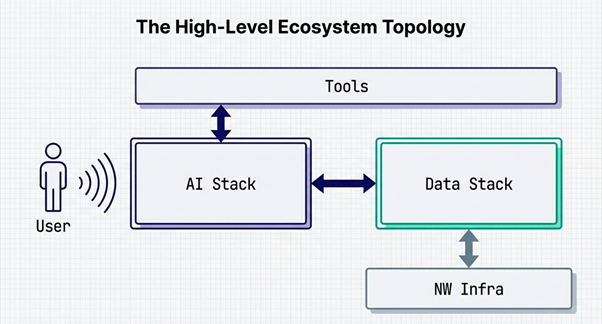
At a high level, the topology is simple. A user interacts with the AI Stack. The AI Stack accesses specialized tools. Those tools communicate with the Data Stack, which plugs directly into the physical network infrastructure.
Three layers. That’s it. The complexity lives inside each one, and LinkEye’s platform is engineered specifically to manage that complexity so the interface stays simple for the people using it.
How Does the AI Stack Work?
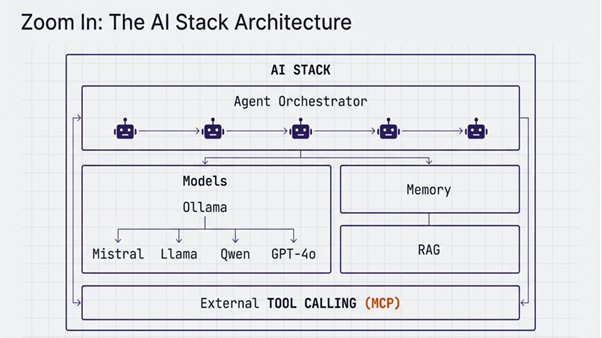
The AI Stack is not a single large language model. It is an Agent Orchestrator managing multiple specialized agents.
Each agent is a piece of software with a specific goal and a specific skill set. These are specialists, not generalists. The orchestrator decides which agent to activate based on the task at hand.
What Do Specialized Agents Do?
A Monitoring Agent watches for anomalies across the network around the clock; it detects rather than troubleshoots. A Wireless Troubleshooting Agent carries deep knowledge of RF interference, roaming failures, and client association issues. An SD-WAN Troubleshooting Agent understands tunnel health, path selection, and application SLAs. A Vendor-Specific Agent specializes in a particular platform, such as Mist, Meraki, or FortiGate, including its quirks, CLI syntax, and known bugs.
The architecture does not rely on a single super-agent that tries to do everything. It relies on dozens of narrow agents, each doing one thing exceptionally well, with the orchestrator routing the right problem to the right agent. This is how expertise scales without scaling headcount.
Why Does LinkEye Use a Hybrid Model Strategy?
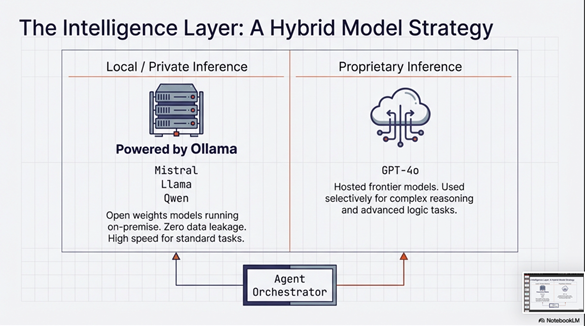
Not every query needs a frontier model. The architecture uses a hybrid intelligence strategy: local, private inference using open-weights models (Llama, Mistral, Qwen, via Ollama) for high-speed, secure, standard tasks with zero data leakage, while selectively routing complex reasoning to hosted models like GPT or Claude. Network telemetry stays inside the environment unless a task specifically requires it to leave.
How Do Short-Term Memory and RAG Fit In?
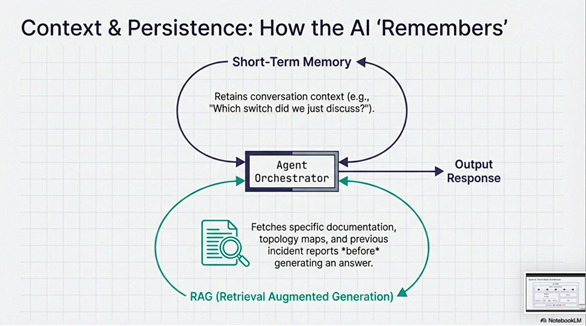
Short-term memory. The AI needs to retain conversation flow. Which switch was just discussed? What was the last configuration change? Without session memory, every interaction starts from zero.
Retrieval Augmented Generation (RAG). Before generating a response, the AI actively fetches topology maps, documentation, runbooks, and previous incident reports. It retrieves first and reasons second, rather than guessing.
How Does Tool Calling Turn Reasoning into Action?
Tool calling is where the AI stops talking and starts acting. Instead of hallucinating CLI commands, it calls structured, validated tools through MCP, such as Ping_Device, Get_Interface_Stats, and Get_Client_Health. The AI never touches the network directly. It calls tools that do.
What Role Does MCP Play in the AI Stack?
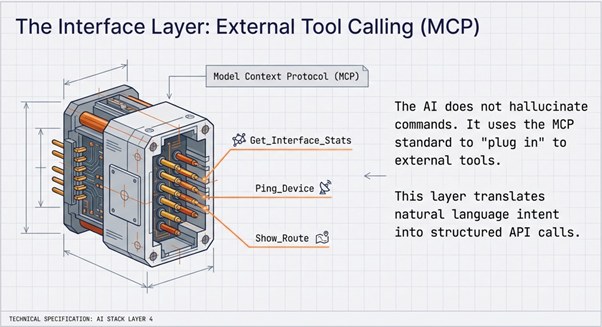
MCP is the architectural decision that makes everything else work. The Model Context Protocol is the standardized interface between the AI Stack and the rest of the world. It prevents the AI from hallucinating actions and translates natural language intent into structured API calls. It acts as the universal language binding the brain to the nervous system.
How Does the Data Stack Turn Network Chaos into AI-Ready Context?
The Data Stack is the buffer between the AI and the physical infrastructure. Its job is to take the chaos of a multi-vendor network and convert it into structured, AI-ready data.
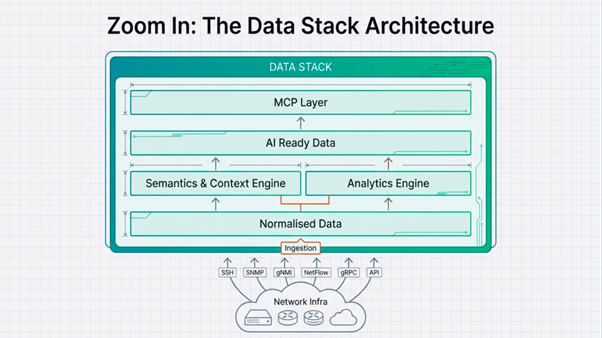
Ingestion. Networks are messy: SSH, SNMP, gNMI, NetFlow, REST APIs, syslog, physical switches, firewalls, and cloud controllers like Meraki, Mist, and FortiGate. The ingestion layer normalizes all of it into a single pipeline, regardless of vendor or protocol.
The Refinery. Raw syslogs and JSON dumps are close to useless to an AI without context. The refinery converts raw data into a common model and runs it through a Semantics and Context Engine. A port is not simply “Gi0/1”; it is tagged as an “Uplink” with “High Severity” when it goes down. The AI receives a clear, structured signal instead of noise.
AI-Ready Data. The Data Stack does not dump raw logs onto the AI. It exposes specific, structured tools via MCP, functioning like a single, standardized plug for data. The AI sees clean functions it can call, such as get_client_health(mac_address) or get_ap_errors(location). Nothing more, nothing less.
What Tools Does an Agent Need Beyond Network Data?
The AI Stack and the Data Stack function as the brain and the nervous system. An agent also needs hands.
In practice, an agent does not just query network data and report back. It operates within an entire ecosystem of operational tools, each connected through MCP or API integrations. These are the tools an agent uses to complete a job end to end, not just diagnose it. LinkEye’s view is that every product in IT operations will eventually support MCP, giving agents native access to the tools operations teams already rely on.
Network Data Tools (MCP to the Data Stack). Structured calls retrieve interface stats, client health, AP errors, and topology data. This is the foundation.
Observability Platforms. Tools like Datadog, Dynatrace, and ELK let the agent pull correlated performance data, synthetic test results, and historical baselines. It does not only see what the network reports about itself; it sees what the monitoring stack reports about the network.
Collaboration Tools. Slack and Microsoft Teams let agents post updates, request human approval before making changes, and escalate when a decision crosses a confidence threshold. This is where human-in-the-loop governance lives.
Alerting Platforms. Tools like PagerDuty and Opsgenie let the agent trigger, acknowledge, or resolve incidents based on its findings. If it diagnoses a fiber cut at 2 a.m. and determines a field technician is needed, it pages the right on-call team with the diagnosis already attached.
Ticketing and ITSM. This is the most critical integration: ServiceNow, Jira Service Management, or whatever the organization runs. The ticketing agent opens tickets, populates them with root cause analysis, attaches relevant logs, assigns the correct priority and category, and routes them to the right team. When it resolves an issue autonomously, it closes the ticket with a full audit trail. Without ITSM integration, an agent behaves like a clever analyst. With it, the agent behaves like an operator.
The key insight is that none of these tools are new. Most organizations already use them. What changes is who is using them. Today, engineers context-switch across six browser tabs to correlate, escalate, and document. With agentic NetOps, agents do that in milliseconds, across every tool simultaneously, for every incident.
Why Does This Architecture Matter?
Four properties make this design defensible.
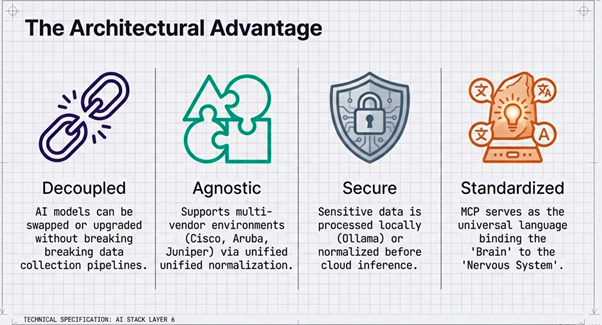
Decoupled. AI models can be swapped without breaking data collection. When a better LLM arrives next quarter, the brain upgrades without rewiring the nervous system.
Agnostic. Multi-vendor environments are supported by design, not as an afterthought. The Data Stack normalizes everything upstream, so the AI layer treats a Cisco campus and a Juniper campus the same way.
Secure. Sensitive data stays local. The hybrid model strategy ensures network telemetry does not leave the environment unless a task specifically requires frontier-model reasoning.
Standardized. MCP acts as the universal contract between AI and infrastructure. There are no custom integrations per vendor and no brittle scripts. One protocol covers all of it.
This architecture is what makes autonomy achievable rather than aspirational
What Does This Architecture Change for Network Teams?
This architecture moves network operations from monitoring to autonomy, from reactive dashboards to closed-loop resolution. It is the structural reason agentic NetOps can move past demos and into production, and it is the framework LinkEye’s platform is built on.