Model capability is not what limits agentic network operations today. Context is. AI agents reason well only when they have a persistent, structured, current picture of a network’s operational reality, including physical state, ownership, dependencies, and contractual constraints. Without that context, a more capable model does not produce better decisions; it produces more confident wrong ones. LinkEye’s Context Engine exists specifically to close this gap.
The Real Constraint on Agentic NetOps
The conversation in most network operations teams starts with the model: which one to use, how to integrate it, whether it can handle the complexity of their environment. These are reasonable questions, but they are not the binding constraint. The binding constraint is context, specifically how much of the operational world an agent can actually see and reason over. Without solving that problem first, model capability is largely irrelevant. This is the problem LinkEye’s Context Engine is built to solve, and it explains why context, rather than the model itself, is the real bottleneck for any team evaluating LinkEye or a platform like it.
Why Is Code Generation Easy for AI and Network Operations Hard?
To understand why context is such a sharp problem in network operations, it helps to understand why AI has been so successful at code generation and what is structurally different about network management.
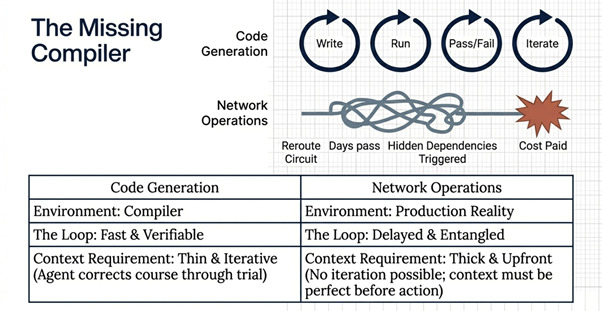
Code generation works because correctness is verifiable. The code runs, tests pass or fail, and the build succeeds or it does not. The feedback loop is tight, unambiguous, and fast. An agent can operate with relatively thin context and still produce useful output because the feedback loop catches errors and enables iteration. The model does not need to understand an entire system to write a function that works; it writes something, the environment responds, and the agent corrects course. This iterative loop is what makes zero-shot code generation increasingly viable even for complex tasks.
Network operations does not have this loop for most of what actually matters. A link is up or down. A BGP session is established or it is not. For binary, verifiable states, agents can be effective. But the consequential decisions in NetOps are rarely binary. Should this circuit be rerouted, given what is running over it and who depends on it? Is a latency spike a hardware problem or a carrier problem, and does that distinction change the escalation path? Is remediating this device tonight worth the risk given what is scheduled for tomorrow morning?
There is no compiler for these questions. Feedback arrives days or weeks later, entangled with other variables, and by then the cost of a wrong call has already been paid. An agent cannot iterate its way to the right answer here. The context has to be right going in.
What Does “Context” Actually Mean in a Production Network?
Most teams, when they think about giving an AI agent context, think about telemetry: SNMP data, flow records, syslog, maybe a CMDB export. These are data sources. They are not context.
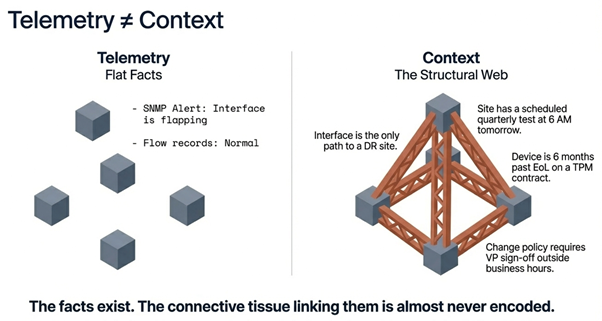
Context is the structural web connecting observations: what relates to what, what drove what, and what a given state implies about what should happen next. Raw telemetry shows that an interface is flapping. Context establishes that this interface is the only path to a DR site, that the site has a scheduled quarterly test at 6 a.m. tomorrow, that the device is six months past end-of-life under third-party maintenance rather than OEM support, and that change management policy for this segment requires VP sign-off outside business hours. Each of those facts exists somewhere. The connective tissue linking them is almost never encoded anywhere, which is exactly the gap LinkEye’s Context Engine is designed to close.
This is what separates a senior network engineer from a new hire: not raw intelligence, but accumulated operational context. A senior engineer does not search for how to handle a flapping interface. They already know what the interface is, why it matters, what constrains the fix, and what fixing it will cost. They reason top-down from a structured model of the domain. A new hire reasons bottom-up from disconnected data points and often arrives at technically correct but operationally wrong conclusions.
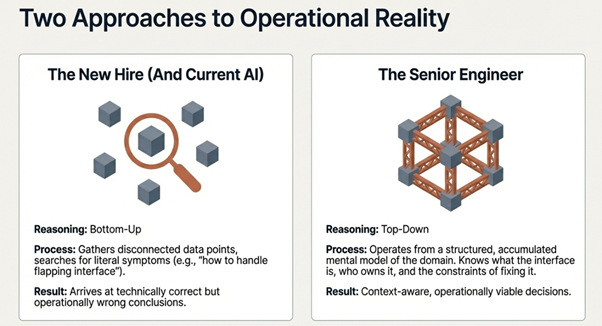
Every agentic NetOps deployment without a context layer operates like the new hire, on every shift. The telemetry is available. The topology is queryable. But the accumulated, structured, logically connected understanding of the network’s operational reality, covering who owns what, what depends on what, and what the contractual and business constraints are on any given action, has to be rebuilt from scratch in every session, because most of it was never encoded in the first place.
The Hidden Layers of Operational Context
The context gap in network operations is wider than it appears, because the relevant information spans layers that are rarely integrated. Physical topology and device state are the obvious ones, and most teams have reasonable tooling here. Operational context extends well beyond them.
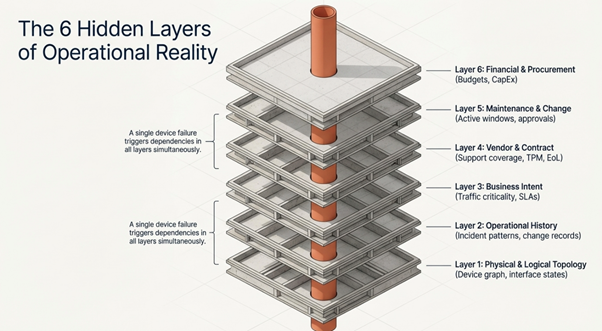
Consider the financial and contractual layer. For every $100 of network hardware, organizations typically carry $60 to $80 in annual operating expenses: support contracts, software licensing, maintenance agreements, and NaaS terms. These are not finance abstractions. They are operationally active constraints that directly determine what any AI agent can actually recommend.
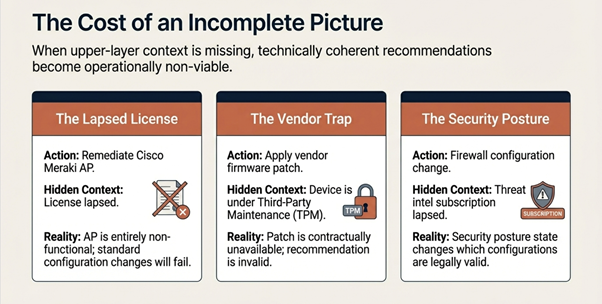
A firewall with lapsed threat intelligence subscriptions is not just a budget item; it is a security posture state that changes which configuration changes are valid. A device under third-party maintenance rather than OEM support cannot receive a vendor firmware patch, which eliminates entire categories of remediation. An access point running a cloud-managed platform like Cisco Meraki stops functioning entirely if its license lapses. The remediation options are categorically different from a traditionally managed device in the same failure state.
Why More Integrations Don’t Close the Context Gap
Once the context problem is named, the instinct is to solve it with integrations: connect the agent to the NMS, the CMDB, the ticketing system, the vendor portal, the contract database. With modern tool-use capabilities, an agent can in principle query all of these simultaneously and assemble context before acting.
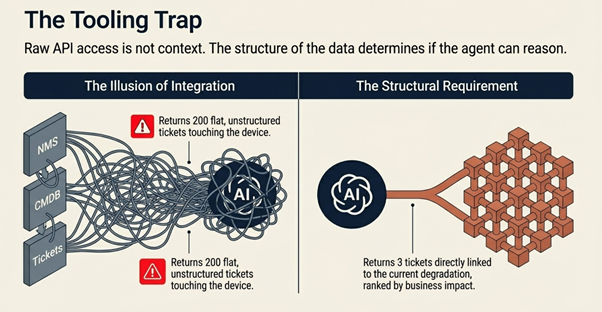
For narrow, well-defined tasks, this works reasonably well. For the judgment-dependent work that makes up most of network operations, raw tool access runs into three structural limitations.
It does not compound over time. Every session starts from scratch. An agent that correctly reasoned through a complex multi-layer dependency last week has no memory of it this week. The organization accumulates no operational intelligence, and the same inductive work gets repeated indefinitely, burning tokens and producing variable results instead of improving.
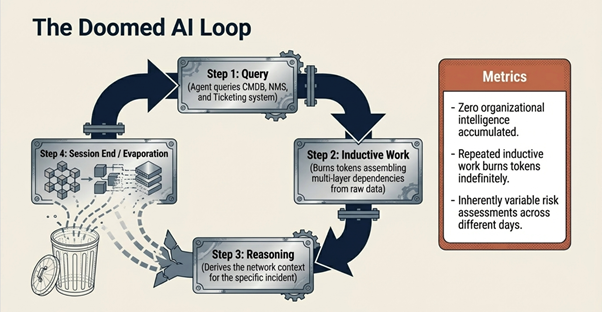
It produces inconsistent conclusions. When an agent re-derives context from raw data each session, the same network state generates different risk assessments on different days, not because anything changed, but because bottom-up reasoning from unstructured data is inherently variable. Network operations decisions need stable interpretation across time, and re-derivation on demand does not provide it.
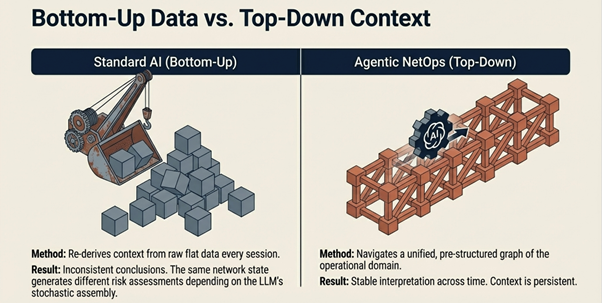
The quality of the primitives is the actual bottleneck. A tool that returns 200 tickets touching a device is not the same as a tool that returns the three tickets directly linked to the current degradation, ranked by business impact. The protocol connecting the agent to the data is not the constraint. What determines whether the agent can reason with the data at all is its structure: whether it arrives as flat records or as logically linked relationships.
What Solving the Context Problem Actually Requires
A production-grade context architecture for agentic NetOps is not simply a better-integrated CMDB. It is a persistent, structurally rich representation of the operational domain, one that connects physical state, operational history, business intent, and contractual constraints into a unified graph the agent can navigate top-down instead of reconstructing bottom-up. This is the model LinkEye’s Context Engine is built around.
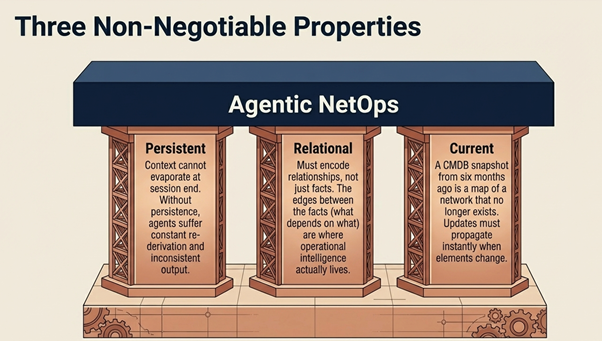
Three properties are non-negotiable.
It must be persistent. Context that evaporates at session end forces constant re-derivation and produces the inconsistency described above.
It must encode relationships, not just facts. Flat observations are not enough. The edges between facts, encoding why things relate and what depends on what, are where the operational intelligence lives.
It must be current. A context model built from a CMDB snapshot taken six months ago is not a context model. It is a map of a network that no longer exists.
The Real Constraint, Going Forward
Models will keep improving. Reasoning will get faster, cheaper, and more capable. Every improvement in model quality is genuinely useful for network operations, and none of it closes the context gap on its own.
The organizations that extract durable value from agentic NetOps will not be the ones that deploy the most capable model against their existing monitoring stack. They will be the ones that treat the context problem as a first-class engineering problem, investing in encoding their operational world with enough fidelity and structural depth that the reasoning engine has something real to work with.